> ## Documentation Index
> Fetch the complete documentation index at: https://schemabrain.mintlify.site/llms.txt
> Use this file to discover all available pages before exploring further.
# Refusals
> A live feed of refused tool calls — what the agent asked for, what category triggered the refusal, and the exact envelope SchemaBrain returned for self-correction.
# Refusals
**Route:** `/refusals` on the dashboard. **Backed by:** `GET /api/audit/refusals` (list) and `GET /api/audit/refusals/{id}` (detail).
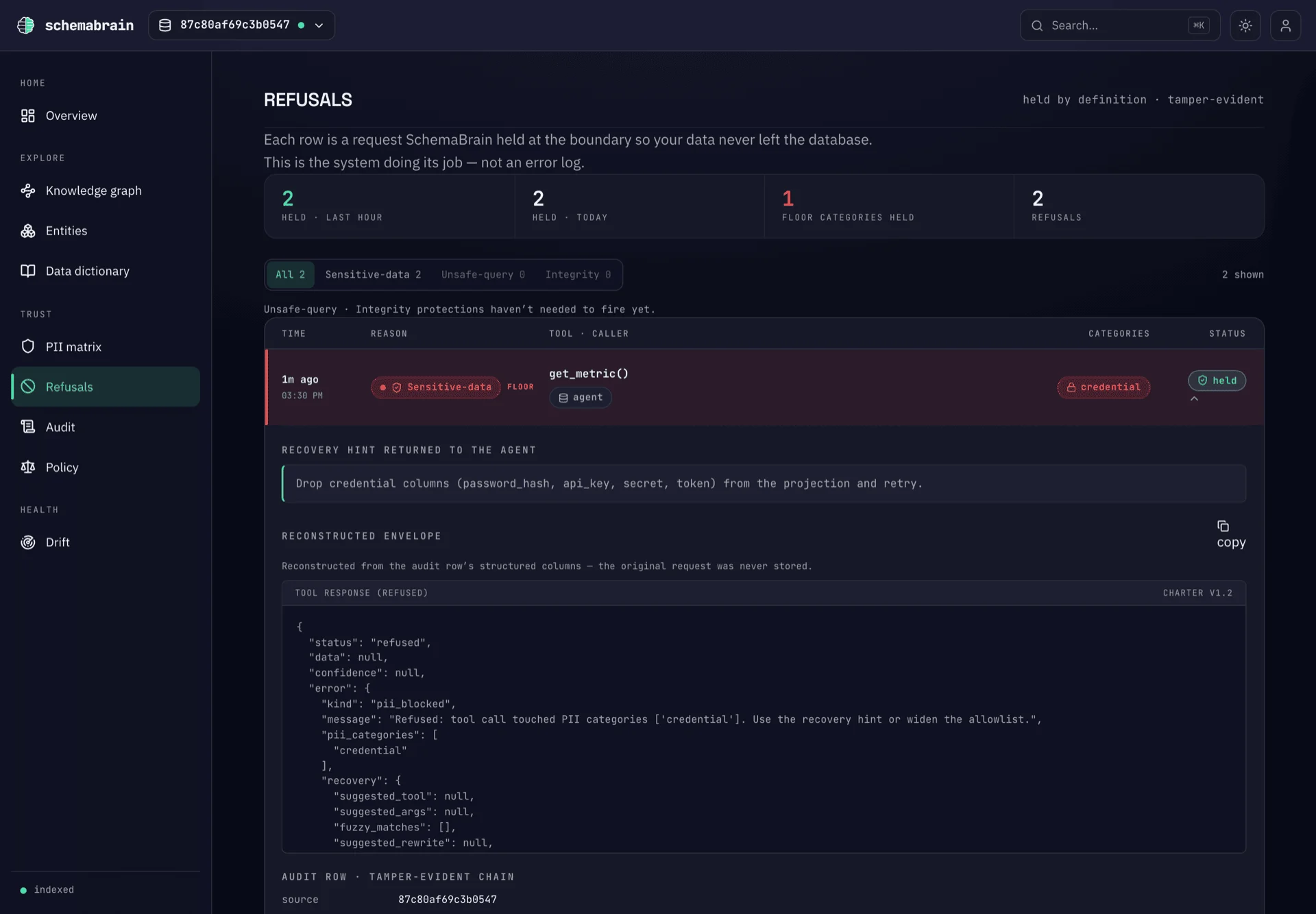 Every tool call that ended with `status='refused'` lands on this surface. The page renders a chronological feed of incidents; expanding any row reveals the full envelope detail inline (what the agent saw, what reason fired, which categories the policy intersected).
This is the surface for two distinct workflows:
1. **Operator triage.** A user complained the agent kept saying "I don't have access to that." Open Refusals, find the relevant row, see exactly what category list intersected the policy. Decide whether to widen `--pii-block` or fix the question.
2. **Recovery quality review.** Read the envelopes SchemaBrain returned. Were the `error.recovery` suggestions actually useful? Did the agent self-correct on the next turn?
***
## What each row carries
Each refusal row in the feed shows the same fields the underlying `mcp_audit` row carries:
| Field | Meaning |
| ---------------- | ----------------------------------------------------------------------------------------------------------------------------------------------------- |
| `id` | The audit row's monotonic ID. |
| `occurred_at` | ISO 8601 timestamp. |
| `tool_name` | The MCP tool that was called (`get_metric`, `describe_column`, etc.). |
| `refusal_reason` | One of `pii_blocked`, `allowlist_violation`, `fragment_unsafe`, `cost_cap_exceeded`, `ambiguous_resolution`, `schema_drift`. |
| `pii_categories` | The category set the envelope returned. **On `pii_blocked` refusals, this is the *blocked* set** — the intersection of policy and request that fired. |
| `cost_class` | `refused` for this surface. |
The detail panel adds the full envelope body: status, the structured `error.recovery` payload the agent received (the suggested tool + args to recover with), and the `chain_hash` that anchors the row in the audit log. (On a `pii_blocked` refusal the recovery rides `error.recovery`; the sibling `follow_up_hints` field is `null`.)
The audit row's `pii_categories` records **only the blocked set** — the categories the policy intersected. The full attempted (propagated) set the agent's plan would have touched lives only on the `PiiBlockedError` exception object and the event bus. See [audit-chain — What this is *not*](/mechanism/audit-chain) for the forensic implication and the roadmap item.
***
## What "refused" means upstream
A refusal is **not** an error. It is a Charter-conformant envelope with `status='refused'` and a structured `error.recovery` block (the suggested tool + args). The agent receives enough information to either:
* Pick a different tool path that does not touch the blocked categories.
* Ask the user to confirm the access is intended.
* Surface a clean "this is policy" message instead of a hallucinated retry.
Each refusal reason maps to a recovery path documented in [Structured Recovery](/mechanism/structured-recovery). Today, `pii_blocked` is the reason the engine actually emits; the other five are reserved, schema-valid enum values whose recovery paths land as those checks ship.
***
## How to populate this view
In normal operation, refused rows accumulate as agents use the MCP server. To verify the surface works end-to-end on a fresh install (or to seed a demo), use the bundled seeding script:
```bash theme={null}
python scripts/seed_refused_audit_row.py --store-path ./schemabrain.db --source-id
```
This writes one synthetic `pii_blocked` row to your local store. Refresh the dashboard tab and the row appears at the top of the feed.
Alternatively, configure a strict `--pii-block` policy on `serve` and ask an agent for a metric that touches a blocked category:
```bash theme={null}
schemabrain serve \
--url-env DATABASE_URL \
--store-path ./schemabrain.db \
--pii-block credential,payment_card,government_id,contact,health
```
***
## Empty state
The page distinguishes "no refusals because the agent never tried" from "no refusals because the policy is empty." If the feed is empty, that is **a good signal** — the agent has been able to do its work without crossing a blocked category. The empty-state message in the UI says exactly that.
If you expect refusals and see none, double-check:
* The `--pii-block` flag on the running `serve` process — pass `--pii-block ''` and it explicitly blocks nothing.
* That `schemabrain index` ran **without** `--no-pii-classify` — without tags, the policy has nothing to act on.
* That the indexed source actually has columns the classifier would flag — heuristic classification has false negatives for cryptically-named columns.
***
## Cross-reference into the audit chain
Every refusal is also a row in the [Audit Viewer](/dashboard/audit-viewer). The two surfaces share IDs — opening row 42 on the Refusals feed and row 42 on the Audit Viewer drawer renders the same underlying row, different facets:
* **Refusals** highlights the envelope the agent received.
* **Audit Viewer** highlights the `chain_hash` and tamper-evidence story.
***
## Related
The envelope shape every refused call returns.
The 12 categories and the catastrophic-leak subset.
Where the refused row lives in the chain.
The flag that produces refusals in the first place.
Every tool call that ended with `status='refused'` lands on this surface. The page renders a chronological feed of incidents; expanding any row reveals the full envelope detail inline (what the agent saw, what reason fired, which categories the policy intersected).
This is the surface for two distinct workflows:
1. **Operator triage.** A user complained the agent kept saying "I don't have access to that." Open Refusals, find the relevant row, see exactly what category list intersected the policy. Decide whether to widen `--pii-block` or fix the question.
2. **Recovery quality review.** Read the envelopes SchemaBrain returned. Were the `error.recovery` suggestions actually useful? Did the agent self-correct on the next turn?
***
## What each row carries
Each refusal row in the feed shows the same fields the underlying `mcp_audit` row carries:
| Field | Meaning |
| ---------------- | ----------------------------------------------------------------------------------------------------------------------------------------------------- |
| `id` | The audit row's monotonic ID. |
| `occurred_at` | ISO 8601 timestamp. |
| `tool_name` | The MCP tool that was called (`get_metric`, `describe_column`, etc.). |
| `refusal_reason` | One of `pii_blocked`, `allowlist_violation`, `fragment_unsafe`, `cost_cap_exceeded`, `ambiguous_resolution`, `schema_drift`. |
| `pii_categories` | The category set the envelope returned. **On `pii_blocked` refusals, this is the *blocked* set** — the intersection of policy and request that fired. |
| `cost_class` | `refused` for this surface. |
The detail panel adds the full envelope body: status, the structured `error.recovery` payload the agent received (the suggested tool + args to recover with), and the `chain_hash` that anchors the row in the audit log. (On a `pii_blocked` refusal the recovery rides `error.recovery`; the sibling `follow_up_hints` field is `null`.)
The audit row's `pii_categories` records **only the blocked set** — the categories the policy intersected. The full attempted (propagated) set the agent's plan would have touched lives only on the `PiiBlockedError` exception object and the event bus. See [audit-chain — What this is *not*](/mechanism/audit-chain) for the forensic implication and the roadmap item.
***
## What "refused" means upstream
A refusal is **not** an error. It is a Charter-conformant envelope with `status='refused'` and a structured `error.recovery` block (the suggested tool + args). The agent receives enough information to either:
* Pick a different tool path that does not touch the blocked categories.
* Ask the user to confirm the access is intended.
* Surface a clean "this is policy" message instead of a hallucinated retry.
Each refusal reason maps to a recovery path documented in [Structured Recovery](/mechanism/structured-recovery). Today, `pii_blocked` is the reason the engine actually emits; the other five are reserved, schema-valid enum values whose recovery paths land as those checks ship.
***
## How to populate this view
In normal operation, refused rows accumulate as agents use the MCP server. To verify the surface works end-to-end on a fresh install (or to seed a demo), use the bundled seeding script:
```bash theme={null}
python scripts/seed_refused_audit_row.py --store-path ./schemabrain.db --source-id
```
This writes one synthetic `pii_blocked` row to your local store. Refresh the dashboard tab and the row appears at the top of the feed.
Alternatively, configure a strict `--pii-block` policy on `serve` and ask an agent for a metric that touches a blocked category:
```bash theme={null}
schemabrain serve \
--url-env DATABASE_URL \
--store-path ./schemabrain.db \
--pii-block credential,payment_card,government_id,contact,health
```
***
## Empty state
The page distinguishes "no refusals because the agent never tried" from "no refusals because the policy is empty." If the feed is empty, that is **a good signal** — the agent has been able to do its work without crossing a blocked category. The empty-state message in the UI says exactly that.
If you expect refusals and see none, double-check:
* The `--pii-block` flag on the running `serve` process — pass `--pii-block ''` and it explicitly blocks nothing.
* That `schemabrain index` ran **without** `--no-pii-classify` — without tags, the policy has nothing to act on.
* That the indexed source actually has columns the classifier would flag — heuristic classification has false negatives for cryptically-named columns.
***
## Cross-reference into the audit chain
Every refusal is also a row in the [Audit Viewer](/dashboard/audit-viewer). The two surfaces share IDs — opening row 42 on the Refusals feed and row 42 on the Audit Viewer drawer renders the same underlying row, different facets:
* **Refusals** highlights the envelope the agent received.
* **Audit Viewer** highlights the `chain_hash` and tamper-evidence story.
***
## Related
The envelope shape every refused call returns.
The 12 categories and the catastrophic-leak subset.
Where the refused row lives in the chain.
The flag that produces refusals in the first place.